
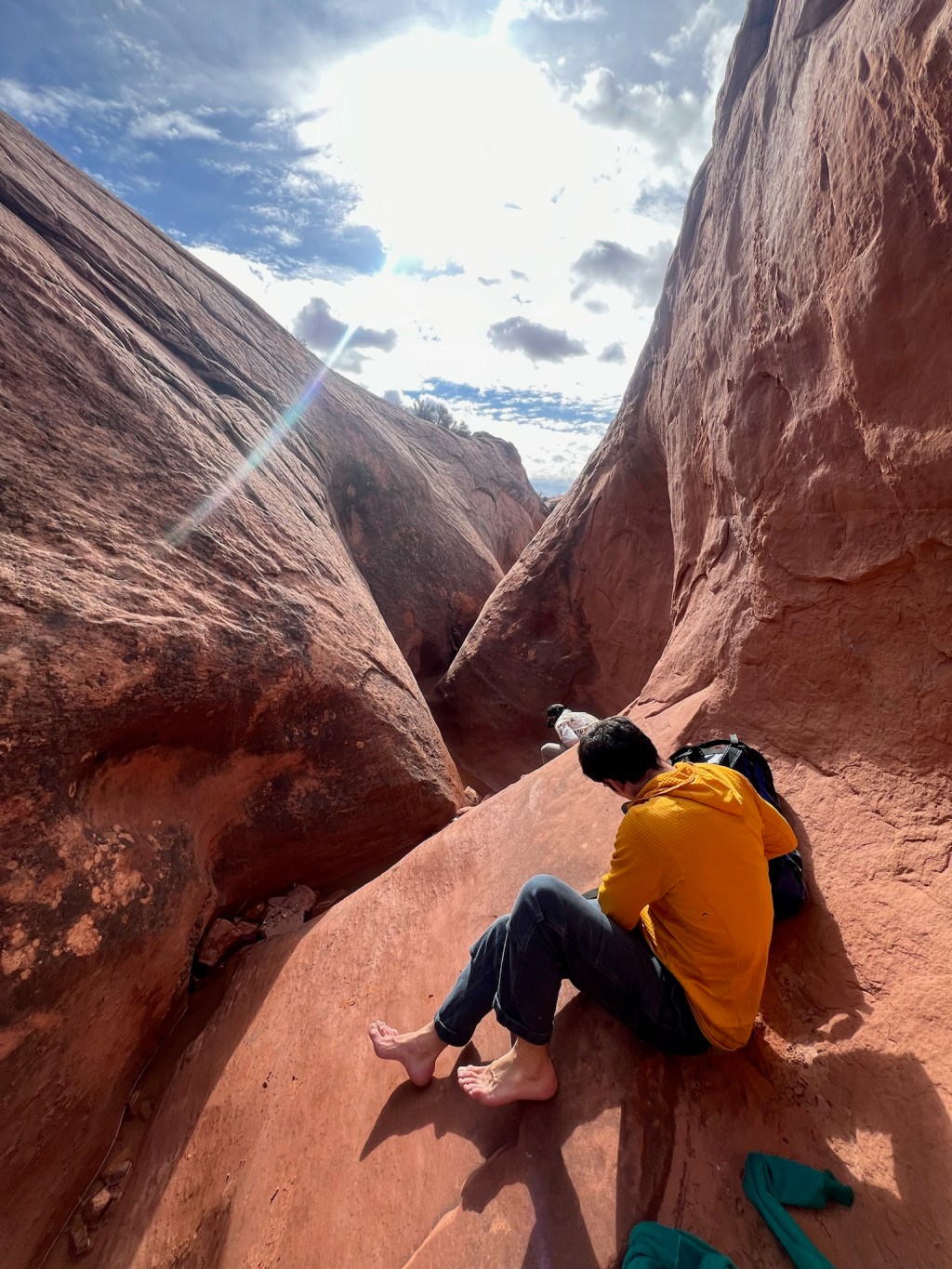
When Whitney, David, and I read about Egypt 3 as a great non-technical slot canyon that would allow us to explore the rugged terrain of Escalante, we couldn’t wait to check it out as an afternoon hike the day before Thanksgiving. After spending most of the hike barefoot and in underwear, and getting back to our rental two hours later than planned, we started to wonder what non-technical really means.
We started down Hole-in-the-Rock road at about 11am and made it to the trailhead around 12:20pm. It had rained quite a bit the night before our hike but we had clear blue skies and about 50 degree (F) air temp in the sun. While Hole-in-the-Rock is a relatively nicely maintained dirt road, Egypt road is much rougher. We couldn’t drive much faster than 15mph most of the way down it in a 4 wheel drive truck. Most AWD and 4WD will be able to make it down the road, but it would be quite easy to end up stranded out there.
The trailhead is totally unassuming – you can see some earlier Egypt canyons from the road but Egypt 3 is hidden. A quick walk down a wash leads to a beautiful slick rock descent into a side canyon that feeds into Egypt 3. When we were there the initial descent was well marked with cairns, but even without markers it would be straightforward to pick the path of least resistance to the bottom. It maybe took us 15 or 20 minutes to get to the start of the canyon.
We were able to stem and avoid the first 50 foot stretch of water successfully. As soon as we landed on a bench afterwards we realized we either needed to turn back or drop our trousers and shoes and wade into the cold pools below. Based on the trip reports we had read we assumed we’d be to the exit of the canyon in about 2 hours and we were sure we’d be warm enough even without pants on. Even without the concern of soaking our pants and shoes, we moved quite a bit slower than anticipate throughout the whole canyon. This canyon is “non-technical” in that we didn’t need to rappel at any point, however navigating the several potholes and deep pools of water while keeping our packs dry required substantially more team work and strategizing than expected.

In addition to a keeper pothole that required a boost in order to get out of, we ran into a couple of slides into water and a few mandatory waist to chest-deep pools. The narrowest portion of the slot required a substantial amount of effort to get a normal sized climbing pack through. Careful breathing and calculated wiggles through these squeezes allowed for slow progress.
Moments of respite were well distributed in the canyon – just when we were getting tired and a bit claustrophobic the canyon would widen enough to walk normally and regroup.
We ultimately made it to the first exit of the canyon about 4 hours after leaving the car – two hours longer than we anticipated. We had been cold at points but weren’t particularly concerned about hypothermia; the consistent movement kept us warm enough and we all had extra layers. While we knew it had rained the night before, we expected a canyon rated 2A (i.e. no or very little water) but Egypt 3 after rain in my opinion is properly a 2B canyon with a substantial amount of water that required specific thought to navigate effectively. While there was one additional slot after the exit we found, it involved a rappel into a deep keeper pothole. We anticipated it would be mandatory swimming considering the high water levels we had already encountered, and with the imminent sunset we decided to save that portion of the canyon for another day.

The exit from the canyon was entirely cross-country and mostly on slick-rock. We had a map of the area downloaded on Gaia and we had the specific GPS track for the canyon and exit downloaded to our phones. Without this information I think it would have taken us substantially longer to navigate through the canyon-laden terrain and find our way back to Egypt Bench Road. As someone who isn’t familiar with canyon country I found it very difficult to orient myself and in the fading light of the day it would have been very easy to get lost in a bad way.

In total, our trip took about 6 hours car-to-car, and about 8 hours house-to-house. We were reasonably well prepared in that we had extra layers, some food and water, and maps downloaded. We would have been better prepared for the trip with some sort of water shoes, an extra towel or two, and some sort of waders or waterproof pants. The canyon is absolutely beautiful and and excellent remote wilderness experience. It would be quite easy to get lost or injured in the narrow slots on this canyon and travelers should take extra care with each step here. Even a small injury could be catastrophic because of the narrow nature of the canyon, the few exit points, and the remote nature of the area. We’d all highly recommend this canyon, but don’t underestimate it!
 Peak of the Week
Leave a comment